


Photo: Healthwise.punchng.com
Dr Ime Okon, who leads Apapa General Hospital in Lagos State and is President of the Medical Women’s Association of Nigeria, Lagos State chapter, received home visits from people urging her not to contest for secretary of the Lagos State branch of the Nigerian Medical Association in 2020. The visitors argued the secretary role involved more work than a woman should handle and that men should do it instead.
“When they came to discourage me from going for secretary, that role is exclusively for males; it’s too hectic. And I said, what’s the difference?. When we were in medical school, did they set our exams differently?” Dr Ime Okon recalled.
She decided to run against two men and won. Senior colleagues commended her tenure as productive and progressive. Dr Okon said the experience made her see the resistance women face when seeking leadership in professional associations in Nigeria, although women are the majority in the health sector.
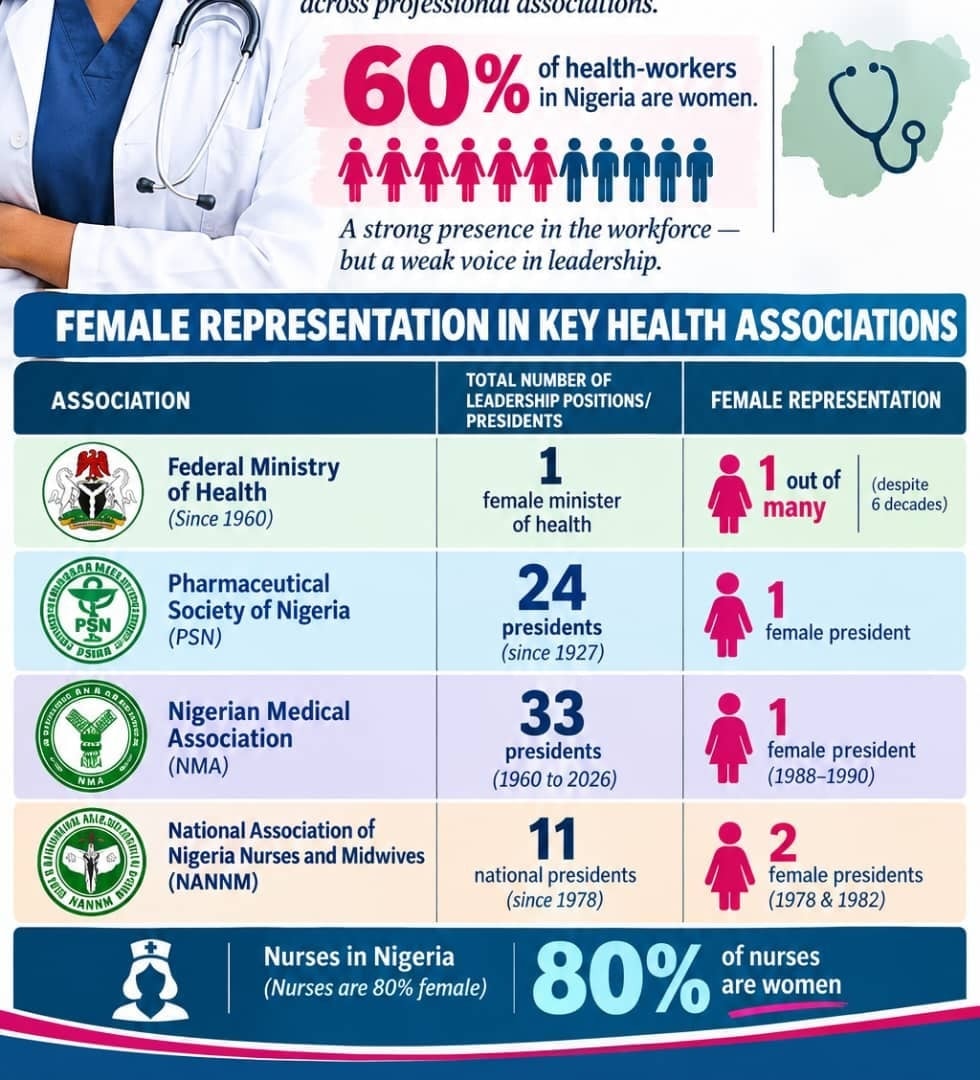
PUNCH Healthwise previously reported that 35% of doctors in the country are women, and women comprise about 60% of health workers. Yet, women rarely reach top leadership in their professional associations.

Women are often encouraged to contest for roles like treasurer or financial secretary but not for top offices in professional groups. Meetings that last until late at night can be very hard to attend for younger women who have to care for children or handle school runs in the mornings.
“Why should it be so toxic and you have to struggle so much because you want to serve?” Dr Ime Okon asked.
An anonymous female gynecologist said her reason for not contesting was personal: “I’ve never attempted. I’ve never even thought about it. I’m just not a very political person. I just feel it’s for other people, not necessarily men.”
She suggested professional bodies should include quotas for women: “If you have already said that, we have slated some positions for women or at least a quota for women. If there are 10 people, we don’t want the 10 to be men. Then women will now know, yes, I can come out.”
An anonymous paediatrician said: “Women are tasked with a lot of things. You have to combine family with work and your personal life.” Both family and leadership require hours of attention, making travel and late meetings difficult for mothers and young professionals.
Since Nigeria’s independence in 1960, out of 25 Ministers of Health there has only been one woman as a substantive Minister of Health and one as Minister of State for Health. The Federal High Court ordered the Federal Government in April 2022 to allocate 35 per cent of public-sector appointments to women, but as of 2026 this had not been put in place. Nigeria ranks 143rd out of 145 countries for gender political empowerment, according to the World Economic Forum’s Global Gender Gap Report 2026.

Mrs Bolanle F.O. Adeniran became the first woman to chair the Lagos State branch of the Pharmaceutical Society of Nigeria in 2017. The president of the Pharmaceutical Society of Nigeria, Prof Ayuba Tanko, said: “More women are now showing interest; at least one contested against me in 2024.” He also noted four out of 12 national executive council members are women, and women now head one technical group and three interest groups.
The National Association of Nigeria Nurses and Midwives has had 11 national presidents since 1978, but only two women have served as national president. The Nigerian Medical Association has had 33 presidents since 1960 and just one woman, Dr Tinuola Abiola-Oshodi, elected National President from 1988 to 1990. Prof Afekhide Omoti, President of the Nigerian Medical Association, said: “Women seeking leadership positions may face greater scrutiny and higher expectations than their male counterparts, while assertive women may be unfairly perceived as aggressive rather than decisive.”
He added, “Leadership should always be based on merit, competence, integrity, and commitment to service.” The association’s 2026–2030 Strategic Plan emphasizes leadership development, institutional strengthening, and succession planning, and women’s medical associations are working on mentoring female doctors to step into leadership roles.
For nurses, similar barriers exist. Comr. Morakinyo Rilwan, National Chairman of the National Association of Nigeria Nurses and Midwives, Federal Health Institutions Sector, said, “Most of them actually feel discouraged because of that.” Night meetings and travel demands remain a challenge, especially for those with family responsibilities. The situation is different across regions; in the South-East, women occupy many leadership roles at branch level.
Beden Barnabas, Sociologist and Executive Director of the Women and Children Health Empowerment Foundation, said: “I believe that if women take leadership positions at association level, it will prepare them for taking leadership positions in political spheres and other areas.”
Barnabas also said women should have fewer domestic tasks such as caregiving: “Women should not have the chunk of domestic responsibilities like caregiving. This would give women an opportunity to network and then to meet with people outside working hours, to be able to move around so that they get those opportunities and probably be in rooms where decisions on who leads and who doesn’t are made.”
Globally, a recent study by the Institute for Health Metrics and Evaluation Women, published in The Lancet Medical journal, states that women now make up nearly 70 per cent of health workers worldwide but remain concentrated in lower-paid professions with fewer leadership opportunities.