
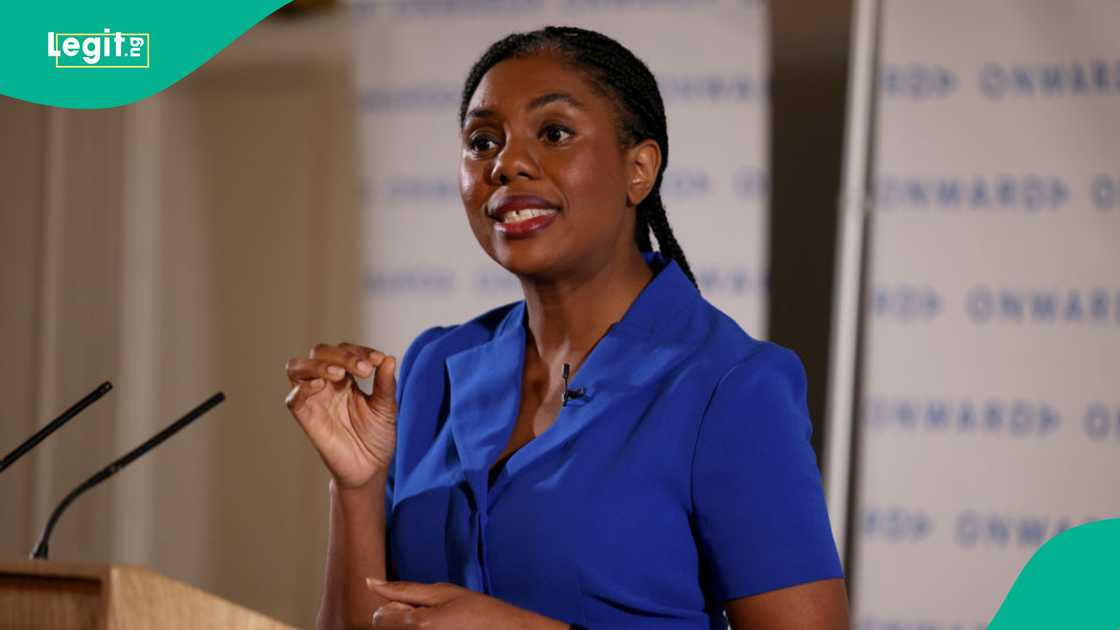
What happens when a celebrated leader’s success story starts to sound like a tale cooked up for effect? Across Nigeria and beyond, many are now asking this question, as Kemi Badenoch’s claims about an American Ivy League dream draw fiery scrutiny — raising eyebrows and sparking debate about authenticity, identity, and aspiration in the diaspora.
For many Nigerians striving to break boundaries abroad, Badenoch seemed to be living the dream. But a fresh controversy is casting long shadows on her celebrated narrative. At the heart of the matter? Her alleged admission and scholarship offer from Stanford University in the United States — a claim now reportedly being challenged by former admissions officials.
Let’s take a deep dive into this explosive development and explore why it’s rattling nerves from London to Lagos — shining a probing spotlight on public figures, Nigerian pride, and the fragile dance between personal truth and political ambition.
Inside the Stanford Controversy: What Did Kemi Badenoch Really Claim?
Once seen as a beacon of Nigerian excellence abroad, Kemi Badenoch — now a prominent Conservative Party leader in the UK — set tongues wagging when she said she was offered a partial scholarship to study medicine at one of the most prestigious US medical schools at just 16. For many, this sounded like something out of Nollywood: a bright young Nigerian plucked from obscurity and courted by global elites. Every parent in Surulere or Enugu knows how proud such a story would make the family WhatsApp group!
But recently, the carpet seems to have been pulled from under this success story. According to The Guardian UK, Jon Reider, who served as Stanford’s admissions officer during Badenoch’s alleged application period, cast doubt on her story. Reider, whose portfolio included handling applications from Africa and offering bursaries, said he was not aware of Badenoch being granted an offer or scholarship to study at the institution.
Now, Nigerians and the international public alike are asking: Did the offer ever exist, or was this one tale too many?
If this was the plot of a film, the tension would be unbearable! But in real life, the stakes are much higher — especially for a leader who frequently appeals to her Nigerian roots on the global stage.
“Although 30 years have passed, I would definitely remember if we had admitted a Nigerian student with any financial aid. The answer is that we did not do so.”
Reider told reporters that while a handful of African students gained admission to Stanford during those years, he had no memory of any from Nigeria, let alone anyone named Kemi Badenoch. For many back home, where “na who sabi book dey get scholarship” is more than just an expression — it’s a whole reality — this revelation felt like cold water on proud expectations.
“O-levels would not have been sufficient, and we would have been very nervous admitting a 16-year-old. She would have had to have an extraordinary record.”
When pressed further about the so-called partial scholarship, Reider stated unequivocally that he would have handled such an award if it truly happened. His words have reportedly deepened skepticism about the entire episode.
“If an applicant needed, say, $30,000 a year to attend Stanford, we would offer them the full amount. There was no point in offering them less because they would not have been able to attend. If we admitted them, we wanted them to enroll.”
Badenoch and Nigerian Identity: Shifting Tunes or Just Playing Politics?
This isn’t the first time Badenoch’s relationship with her roots has become lightning rod for discussion. Who can forget when, during her early trek into UK politics back in 2010, she appealed touchingly to her Nigerian heritage? Naija people love to hear “my people,” especially from potential leaders overseas who remember their homeland while chasing big dreams abroad.
But chop-and-change can be a risky move. In the years that followed, Badenoch made controversial remarks about her Nigerian schooling — likening it to being “locked up” and describing it as a kind of “prison.” Later, she even claimed to have shed that part of her identity, saying publicly she no longer sees herself as Nigerian.
For plenty Nigerians — from university students hustling to Japa, to professionals in Ikeja and Abuja — such statements strike a nerve. Is identity something we wear and discard depending on where the political wind is blowing? Or is it a fire we must tend, even when far from home?

Photo credit: Kemi Badenoch
Source: Facebook
Nigerian Voices React: Pride, Pain, and Mixed Feelings
On the streets of Lagos, at viewing centres in Abuja, or even across Twitter threads, reactions have been diverse and heartfelt. Some Nigerians feel deeply disappointed, asking whether politicians abroad sometimes exaggerate their stories to gain support. Others argue that the tough scrutiny is a double standard often reserved for minorities making waves in foreign lands.
Dr. Funmi Adeyemi, a legal analyst based in Lagos, notes: “This issue touches not just on politics, but on the larger struggle for Nigerian representation and credibility in global institutions.” She adds that while every public figure’s claims should be properly checked, “it’s important not to let our genuine hopes be hijacked by half-baked or unproven stories.”
Others have said it is crucial to protect Nigeria’s image internationally, suggesting leaders must avoid making unsubstantiated claims, especially about academic or professional achievements. “If owu de blow, no weavon go remain. We must always stand on solid ground,” one Ibadan-based commentator joked online — using this playful idiom to stress the need for honesty.
Badenoch on Racism and the Meaning of Representation
In a related twist, Badenoch herself recently spoke out about the racist abuse she’s endured since becoming the first Black woman to lead her party. According to her, malicious voices and ethno-nationalist trolling are all too frequent in today’s politics, both at home and abroad. She maintains that her achievements, no matter how questioned, have faced obstacles far bigger than mere paperwork.
Even as the controversy swirls, Badenoch prepares for a decisive conference moment, with many eyes watching how she balances her Nigerian heritage with her UK political ambitions. The pressure, as they say, no be beans!
Observers note that Badenoch’s experience echoes a much bigger struggle: How do Africans in the diaspora uphold integrity and authenticity under the world’s spotlight? Are public statements meant to inspire, or must they always be grounded in iron-clad evidence?
Why This Story Matters to Nigerians at Home and Abroad
- Global Image: When prominent Nigerians are accused of embellishing their records, it can make things tougher for others seeking scholarships and opportunities abroad.
- Trust and Representation: Diaspora leaders shape perceptions of Nigeria’s future — their stories influence how global institutions view us.
- Lessons for Youth: Aspirational tales should encourage — not mislead — the next generation of Nigerians striving for greatness.
Is this just one public figure’s misstep, or does it expose a deeper issue with how we tell our stories — both to ourselves and the world?
What’s Next? The Road Ahead for Badenoch and Diaspora Nigerians
Whether or not Badenoch can clear up the controversy around her scholarship claims, one thing is certain: the world, and Nigeria in particular, is watching closely. It’s a sobering reminder that when you climb to the top, every syllable and every story counts, especially when you are carrying the hopes and dreams of many on your shoulders.
As diasporans continue to contribute at the highest levels in international politics, business, and academia, their victories — and their setbacks — reflect on the nation that shaped them. For young Nigerians everywhere, integrity may just be the most valuable passport of all.
What do you think: Are high-profile Nigerians held to higher standards abroad, or do they have a duty to be extra careful with their stories because of what’s at stake? Na your turn to yan! Share your thoughts in the comments and follow us for more updates as this issue unfolds.
For general support, reach out at support@nowahalazone.com.
Stay connected for more breaking news and exclusive insights. Follow us on Facebook, X (Twitter), and Instagram for the latest updates!