
What happens when authority collides with uniformed power in the very heart of the nation? Abuja’s Gaduwa District recently became the stage for an explosive drama that has left Nigerians questioning the deep undercurrents of power, corruption, and entitlement surrounding land in our Federal Capital Territory. The incident, which took place amid the dusty bustle of a disputed land site, is causing wahala in both political and military circles.
Inside Story: A Confrontation That Reveals More Than Meets the Eye
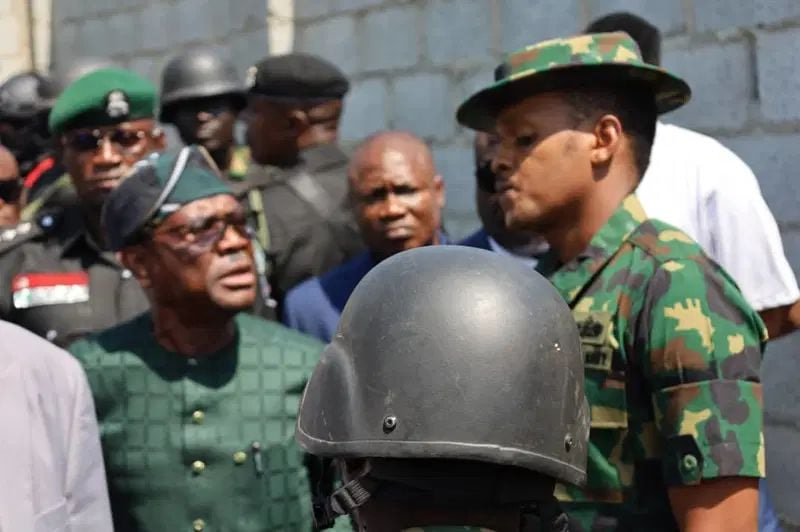
Picture this: a Tuesday morning in Abuja, with its usual mix of traffic blare and hurried pedestrians. Suddenly, shouts break the air at a fenced Gaduwa plot. The Minister of the Federal Capital Territory, Nyesom Wike, who has built a reputation for directness, finds himself face-to-face with a naval officer reportedly guarding contested land—land that, according to various insiders, sits at the core of a larger game played by powerful hands behind the scenes.
As onlookers watched, Wike’s exchange with the officer grew heated. The Gaduwa scuffle didn’t just pit a government minister against a junior officer—it opened a can of worms about the legitimacy of land deals and the willingness of some to use state power for private interests. Can land disputes in Abuja ever be merely about land? Nigerians are asking themselves, “Who truly owns the FCT?”
Joe Igbokwe’s Take: Corruption, Entitlement, and the Battle for Abuja
Enter Joe Igbokwe, chieftain of the All Progressives Congress, who didn’t mince words in his reaction. On his social media page, Igbokwe described the officer’s conduct as “horrible” and “representing evil.” According to Igbokwe, what happened that morning wasn’t just a simple act of official impunity. It spotlighted the deep sense of entitlement and “rot” in Abuja’s land administration.
He questioned: “What this small boy displayed today has a million meanings. What frightens me is the reactions here. Who sent him on this horrible mission? Of what meat is he fed?” His words dripped with frustration and suspicion, echoing what many civil servants and ordinary Nigerians feel about how land often becomes a chess piece for the well-connected.
Igbokwe didn’t stop at the officer. He suggested that Abuja’s entrenched elite—whom he called “shameless land grabbers”—fear Wike’s reform drive. According to Igbokwe, those who have thrived on questionable land deals “will not like” a tough-talking Southerner shaking up their comfort zone.
First Southern FCT Minister in 30 Years: Why Does It Matter?
You might be wondering, why all this noise? Igbokwe pointed out a historical first: Wike is reportedly the first Southern Nigerian to become FCT Minister since Abuja became the capital over 30 years ago. “For more than 30 years, FCT minister has always come from the North. In 2023, Wike became the FCT minister and hell was let loose,” Igbokwe noted. This break from tradition, some say, has unsettled old networks and revived debates on regional equity, federal character, and control of the capital’s most prized resource—land.
Diving Deeper: Who Owns Abuja’s Land—and At What Cost?
Beyond the shouting and viral videos, bigger questions linger. Who is the real owner of the Gaduwa land in question? Was the allocation done according to due process? Igbokwe demanded a thorough investigation and asked why those behind the scene keep sending “errand boys” instead of showing face themselves—questions that Nigerians have echoed in barbershops, markets, and online forums across the country.
Legal experts say Abuja’s land regime operates by presidential allocation, with the Minister acting as the chief custodian. Yet there’s a long-running problem: alleged abuse of power by successive officials, hoarding of land by the powerful, and forcible takeovers that push the ordinary man to the fringes. “Until the government digitizes and opens up the land registry, this kind of drama will never end,” argued Barrister Ayo Alade, a property rights advocate in Lagos.
National Security Anxiety: Is This Just a Land Dispute?
While the Gaduwa clash might sound like regular Abuja politics, some commentators view it as an explosive national security concern. Social commentator Adedamola Adetayo, popularly known as #BalogunKakanfo1, described the incident as a dangerous affront to civil authority—what he likened to “an equivalent of a coup d’état.”
Adetayo did not mince his words: “The recklessness of this incident is in the ex-Naval chief giving orders to the Lieutenant to undermine the authority of the agents of the Commander-in-Chief.” He argued that such insubordination, if left unchecked, could erode the authority of civilian leadership and return the country to the dark days of confusion between military and democratic mandates.
He highlighted a broader social challenge: “We became used to too many acts of illegalities, indiscipline, lawlessness, disorder, corruption over the long years of military misrule that we don’t seem to understand any more what should be normal.”
The Streets Speak: Ordinary Nigerians Weigh In
Everyday Nigerians are not quiet about the situation. “If soldiers can argue publicly with a serving minister, it’s small time before common citizens begin to take laws into their own hands,” said Ngozi Ugwu, a businesswoman trading in Wuse Market. “We need to know that nobody, no matter the uniform, is above the law.”
Jide Owolabi, a civil servant who has dealt with land application delays, put it this way: “Abuja land issues have frustrated many. From fake allocations to land grabbers using connections, it’s the poor man who suffers most.”
What Next for Abuja Land Disputes?
Legal analysts and civic society groups are now calling for transparent probes, digitization of FCT land records, and obedience to rule of law. The FCT Ministry, for its part, maintains that it is acting within its mandate. No matter which side of the debate you fall, the Gaduwa incident is more than just a viral video. It’s a mirror to our ongoing struggle for fair governance, proper land reforms, and respect for civil authority in Nigeria’s seat of power.
The Big Question
Should uniformed officers take the law into their own hands, especially when land disputes have deep implications for national unity and stability? Is it time for a complete overhaul of Abuja’s land allocation system, or do we risk more chaos if rushed reforms sideline key stakeholders?
What’s your view about Abuja land matters and the clash between Minister Wike and the naval officer? Has land allocation ever affected you or your community? Drop a comment below and join the conversation—your perspective matters!
Have a tip, opinion, or your own story about Nigeria’s land issues? Want your experience featured or wish to sell your story?
Reach out to our editorial team at story@nowahalazone.com.
For general enquiries or support, email support@nowahalazone.com.
Never miss an update! Follow us on
Facebook,
X (Twitter), and
Instagram to get the latest on issues affecting you and your community.