
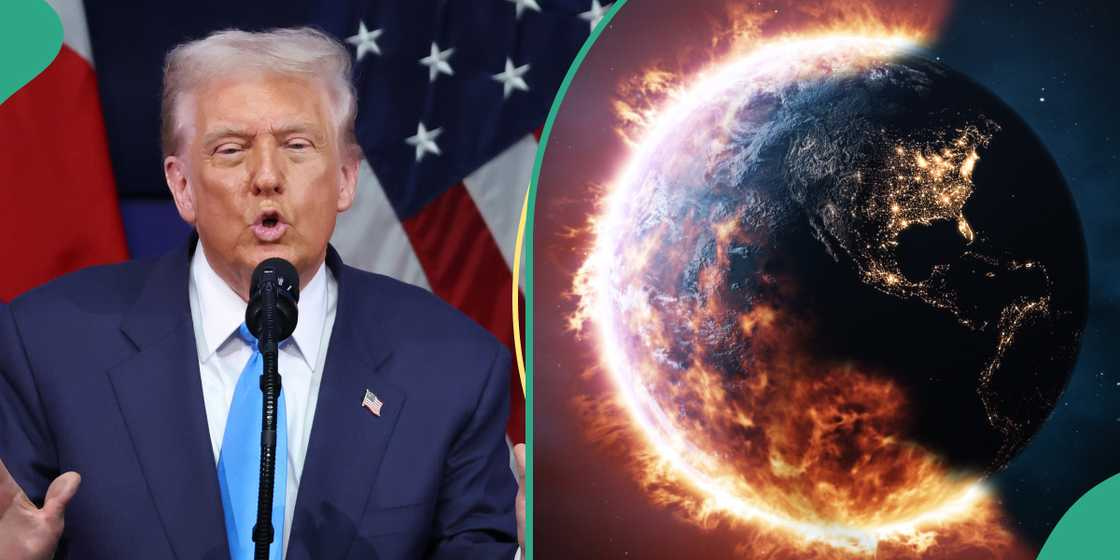
Can you imagine waking up to breaking news that could change the entire world’s security game overnight? That’s exactly the kind of shock many felt as President Donald Trump announced a controversial move to resume US nuclear weapons testing — the first in nearly three decades. For those of us watching global affairs from Nigeria, this isn’t some distant drama. Decisions like this have serious ripple effects, touching everything from oil prices to continental security alliances.
Reportedly, President Trump believes the renewed tests are necessary to keep up with Russia and China, countries he says are “not playing small.” The announcement exploded onto social media, just moments before the president’s anticipated meeting with China’s Xi Jinping in South Korea, according to the BBC.
“Because of other countries testing programs, I have instructed the Department of War to start testing our Nuclear Weapons on an equal basis.”
The world held its breath, waiting to see what would happen next.
Shattering A 30-Year-Old Nuclear Testing Ban: What’s Behind This US Decision?
It’s hard to ignore the weight of history here. The United States last carried out a nuclear test back in September 1992, following the Cold War’s end. Then-President George H.W. Bush froze nuclear detonations, leading to a long-standing moratorium. Several leaders after him toed that line, pressing instead for non-proliferation and peace deals.
But this new directive, officials say, represents a sharp U-turn in US nuclear policy. Trump openly touted America’s nuclear arsenal—calling it the world’s largest, with Russia trailing close behind and China, as he termed it, “a distant third.” Still, he insisted that a stronger and modernized arsenal is now crucial, suggesting China’s own program would overtake expectations “within 5 years.”
He reportedly told the world this move was “no choice,” stressing the need for American military strength and technological readiness. Yet, the exact scope and timeline for these tests, including suitable sites and methods, weren’t revealed immediately. As he told journalists, details would follow, but the process would kick off post-haste.

Source: Getty Images
Global Jitters: Could a New Arms Race Be Brewing?
This shocking decision hasn’t gone unnoticed. In fact, it’s thrown the international community into a fresh debate. Russia, only days before Trump’s statement, reportedly tested an advanced nuclear-powered missile said to fly “unlimited range,” according to international defense analysts. Imagine the tension that built up as news bounced between Moscow, Beijing, and Washington!
Experts warn this isn’t just about showing off firepower or flexing muscles. The Center for Strategic and International Studies notes that China has doubled its nuclear arsenal in the last five years, with forecasts saying they could surpass 1,000 warheads before 2030. Meanwhile, the Arms Control Association estimates that the US holds about 5,225 nuclear warheads, with Russia close at nearly 5,580. The numbers sound like something out of a Hollywood script, but these are the real sums shaping global security as we speak.
Back home in Nigeria, even if we don’t have nuclear warheads, we feel the heat. Rising global tension often leads to economic instability, higher oil prices, and more pressure on developing nations to pick sides. In Abuja, one geopolitical analyst compared the renewed arms competition to “a high-stakes chess game where everyone prays they aren’t the next pawn.”
Examining the Fallout: Local and International Perspectives
It’s not surprising that peace advocates across Africa have voiced concern. Oluwatobi Akande, a Lagos-based researcher on international security, explains, “For us in Nigeria, these decisions may amplify tensions in the Niger Delta and also affect how foreign investors look at Africa as a whole.” The risk of renewed global arms build-up doesn’t stop at national borders — it reverberates through supply chains, peacekeeping missions, and global markets like a stubborn echo.
The US announcement reportedly lands just 100 days before the New START Treaty with Russia might expire. This treaty, signed in 2010, is currently the only agreement limiting the world’s two largest nuclear powers to 1,550 deployed warheads each. The clock now ticks loudly – will Washington and Moscow renew or let the deal collapse?
Across the globe, there’s little appetite for a repeat of the Cold War. But as experts point out, strategic ambiguity can sometimes be just as risky. The Nevada Test Site—where the last US detonation occurred in 1992—is still reportedly ready for action. Some fear that fingers itching on the test button could mean more countries will jump back on the nuclear bandwagon, making the world even less predictable.
Nobel Peace Prize: Another War of Words
As if the nuclear drama wasn’t enough, President Trump’s White House also found itself at odds with the Nobel Peace Prize committee. According to official statements, the US president, having branded himself a peacemaker for ending multiple foreign conflicts, was surprisingly absent from the winners’ list.
Steven Cheung, the White House communications director, didn’t mince words, describing the committee as biased after the decision. It sparked its own debate online, with some in Nigeria drawing comparisons to other major international snubs and questioning the politics of such prizes. For many, it was one more reminder that global politics is never straightforward — “na so life be.”
Looking Ahead: What Does This Mean for Nigeria and Africa?
So, should Nigerians be worried? The answer isn’t black or white. While Nigeria is not a nuclear state, our country’s security, economy, and foreign relations are all woven into this complex tapestry. International agreements — or the lack of them — can directly impact UN peace operations, economic investment, and even student visas. With oil and gas remaining key exports, any major instability affecting global markets is “everybody’s wahala.”
Experts suggest that African leaders need to double down on building regional security frameworks, expanding diplomatic ties, and engaging in global dialogues about arms control. As world leaders shift the chessboard, “we can’t afford to play ‘sidon look’,” warns a West African policy analyst. To stay safe and secure, the continent must be proactive, well-informed, and united.
- Key Takeaway: America’s decision to resume nuclear testing is a major policy shift with unpredictable consequences, and every continent – including Africa – has a stake in the outcome.
- African nations should stay informed, unite diplomatically, and invest in peace initiatives to weather these storms.
- Everyday Nigerians should watch closely — not out of fear, but as stakeholders in a rapidly changing global landscape.
What lies ahead for global security and how might Nigeria navigate these uncertain waters? Share your thoughts below and keep the discussion rolling!
Do you have a tip, opinion, or a headline-making story about international politics or local security you want to share or sell?
Reach out to us at story@nowahalazone.com to get your story featured or discuss story sales.
For general support, contact us via support@nowahalazone.com.
Connect with us on Facebook, X (Twitter), and Instagram to stay updated on global and local news!