
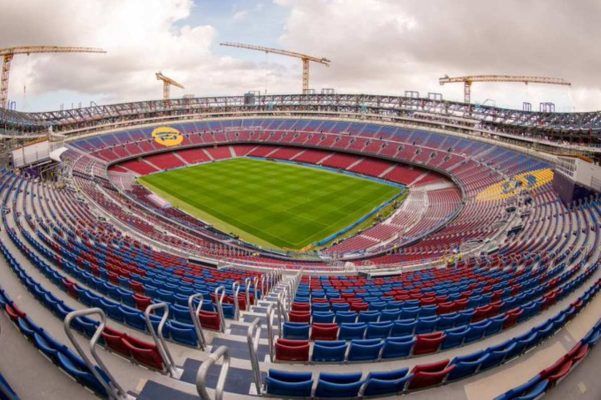
Picture this: For two years, the mighty roar of Camp Nou—the temple of football in Barcelona—fell silent as bulldozers and scaffolding replaced cheering fans. Now, a fresh chapter is set to unfold. The iconic stadium, home to football legends and wild dreams, is preparing its long-awaited comeback. But will it return with a bang or just a whisper?
Football devotees from Lagos to Kano know how the atmosphere inside a packed stadium can give you goosebumps. In Nigeria, viewing centers are often bursting at the seams when Barcelona is playing—sometimes, you’d think you were right there in Catalonia! So, it’s big news that Barcelona is gearing up for a triumphant return to Camp Nou—though, for now, on a much smaller scale.
Camp Nou’s Return: A New Dawn, But No Full House Yet
According to Barcelona officials, the team will officially return to the Spotify Camp Nou for an open training session on Friday, November 7. But here’s the kicker: only 23,000 spectators will be admitted—a far cry from the legendary 105,000-fan capacity Camp Nou is known for. For context, that’s fewer than the crowd at some Lagos markets on a busy Monday morning!
Why so few? Renovations that began over two years ago are still dragging on, reportedly hampered by construction delays and safety concerns. City officials currently allow a maximum capacity of 27,000 spectators, citing issues like evacuation routes and other safety checks. The famous ‘wall of noise’ will have to wait, but fans are still buzzing with excitement.
Inside Story: Charity, Safety, and the Unfinished Spectacle
The return may be modest, but it’s not without significance. As Barcelona announced on their website, not only is this open session a grand homecoming, but ticket proceeds—set at five euros for club members and ten euros for the general public—are earmarked for a club charity supporting sick children. In true community spirit, football is giving back, just as local football competitions in Nigeria often use proceeds for local causes or school outreach.
But let’s not paint everything rosy. After two years and a reported €1.5 billion spent on renovations, the stadium is still not ready for full-fledged matches. According to the club, the upcoming event will serve as a crucial “technical and operational test,” making sure all systems, access points, and facilities can cope before matches resume. Even the city’s fire brigade has raised eyebrows over evacuation plans. And until the ground can safely host at least 45,000 fans, Barca will have to keep playing at the Olympic Stadium in Montjuic.
Counting the Cost: Setbacks and Financial Strain
For a club of Barcelona’s stature, financial stability rides on the back of those massive home crowds. Revenue from ticket sales, merchandising, and VIP experiences at Camp Nou is what keeps the lights on—and some analysts say every delay is a blow to an already troubled balance sheet. With the reconstruction budget reportedly ballooning to €1.5 billion, the club is walking a financial tightrope. This is a reality Nigerian football club owners know all too well: without steady matchday earnings, things can get tough, sharp sharp!
It’s not only about numbers. Fans across Africa, who wear their Barca jerseys with pride, have shared mixed feelings. “We miss the real Camp Nou. Watching them in Montjuic is just not the same vibe,” says Chinedu, a die-hard supporter from Surulere. Others are hopeful, saying a fresh stadium will attract new investment and top talent in the long run.
Global Stage: Champions League Finals and Europe’s Elite
As Camp Nou’s doors creak open, European football is already looking ahead to the next big showdowns. The Allianz Arena in Munich stands alone as the candidate for the 2028 UEFA Champions League final, according to various sources including UEFA statements. Paris Saint-Germain’s dramatic demolishing of Inter Milan in 2025 is still fresh in the memory of fans worldwide. Germany’s Allianz Arena has hosted the prestigious final several times: 2012, 2025, and now likely again in 2028. Meanwhile, Budapest will welcome this season’s final, with Madrid’s Metropolitano lined up for 2027.
And there’s more on the horizon. The race for the 2029 final is heating up, with UEFA reportedly deciding between London and Barcelona come September 2026. If Camp Nou finishes its renovations in time, it could once again shine as a stage for European football royalty—a prospect that would thrill West African fans who tune in religiously to every Champions League clash.
What Does This Mean for Nigerian Football Lovers?
If you’re one of those fans who never misses a Barca match, you know the struggle of watching games in cramped viewing centers—sometimes with the generator blaring in the background. The bounce-back of Camp Nou symbolizes more than just a sporting venue’s reopening: it’s a reminder of why football matters so much to us. It’s about community, hope, and that electrifying feeling you get when your team finally comes home.
- Local impact: Expect even bigger crowds at Nigerian viewing centers as Camp Nou’s partial reopening draws closer—everyone wants to witness history, even from afar!
- Youth inspiration: Many Nigerian youngsters idolize Barcelona stars. This slow but steady return will keep the dream alive for future superstars hoping to step onto a world-class pitch someday.
- Lessons to learn: The ongoing construction woes at the Camp Nou highlight the need for better stadium management and safety—key issues for Nigerian stadiums too.
Balanced View: The Road Ahead Is Still Bumpy
It’s not all celebration and fanfare. Delays, financial losses, and safety concerns have cast long shadows. Club officials and city authorities are reportedly under pressure to get things right, according to Spanish press briefings. Some question whether such a massive stadium overhaul is worth the financial headache, particularly as the wider footballing world battles economic turbulence. As we say here, “No be every chop belleful,” meaning: not every flashy project brings full satisfaction.
Still, there’s no denying the sense of anticipation building up—not just in Spain, but in every corner of Africa where football unites young and old. With the reopening, however gradual, the hope is clear: to see Camp Nou regain its place as the beating heart of football glitz and glory.
Will Camp Nou Restore Its Magic?
Can Barcelona’s beloved stadium recapture the raw magic of its glory days? Will the financial risks pay off, and can other African clubs learn from Barcelona’s playbook on large-scale stadium projects? One thing’s for sure—on November 7, the eyes of the footballing world will be fixed firmly on Camp Nou’s historic pitch, expecting drama, renewal, and maybe a few surprises.
Over to you: As a Nigerian fan, does the slow return to Camp Nou get your heart racing, or do you worry the magic has been lost in all the construction delays? Have such big stadium projects worked in Nigeria, or do you think smaller is better? Drop your thoughts below and share your Barca story!
Email us your unique stories or even sell your exclusive tip at story@nowahalazone.com.
For support or general news submissions, reach us at support@nowahalazone.com.
Keep up with the latest sporting updates and behind-the-scenes gist by following us on
Facebook,
X (Twitter), and
Instagram.
Your insight could inspire millions and keep everyone in the loop—don’t dull!